
Home/Products/Disposable & Capsule Filters/Sterile Hydrophilic PVDF Capsule Filter
Sterile Hydrophilic PVDF Capsule Filter

Sterile Hydrophilic PVDF Capsule Filter

Product ID: sterile-hydrophilic-pvdf-capsule-filter|PVDF

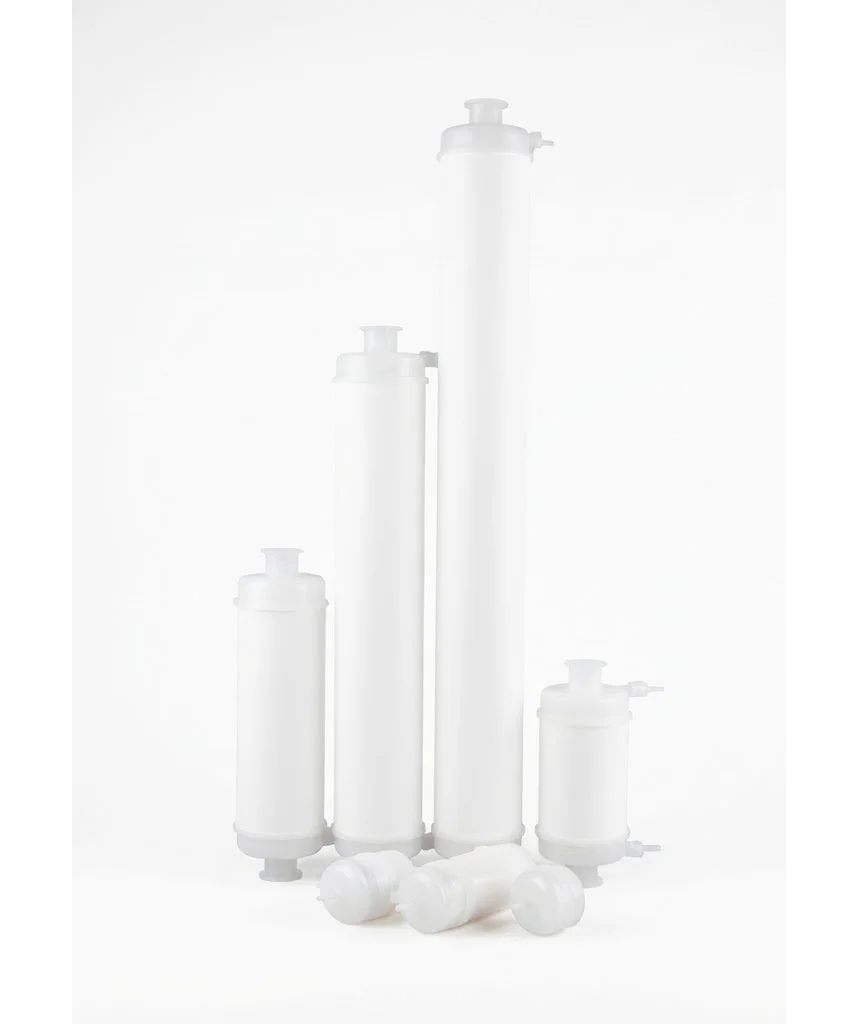
Hydrophilic PVDF capsule filter designed specifically for high value biopharmaceuticals. It has the lowest protein adsorption rate and extremely low precipitate background on the market. Validated for sterilization levels with LRV greater than 7 and available with double-layer membrane long-life options. It is the top solution for vaccines, biological reagents, sterile eye drops and antibiotic filtration.

  • Market-leading lowest protein binding
  • Ultra-low extractables background
  • LRV greater than 7 sterilizing-grade validated
  • Dual-layer long-life option
  • Hydrophilic, no pre-wetting
Micron rating
0.1, 0.22, 0.45, 0.65 µm
Max operating temperature
Continuous service to 60 °C
Effective filtration area
≥ 0.7 m² per 10" media section
Max forward differential pressure
Forward 4.0 bar (58 psi) @ 25 °C
Vaccine filtration
Biological reagent filtration
Sterile eye drop filtration
Antibiotic filtration
High-value biopharma sterile processing
Filter media / membrane
Hydrophilised polyvinylidene fluoride microporous membrane — among the lowest protein-binding media available, with a low extractables background, which matters for vaccines, biological reagents, sterile eye drops and antibiotics where lost potency is expensive. A double-layer long-life option is available
Support & drainage layers
Polypropylene support and drainage layers; a PVDF support and shell can be specified for oxidising feeds
Body material
One-piece polypropylene shell and end caps, thermally welded throughout with no adhesives; no metal parts in the wetted path
Seals / O-rings
The body is thermally welded and has no main O-ring; port gaskets in silicone or EPDM, with FKM available for aggressive fluids
Micron rating
0.1, 0.22, 0.45, 0.65 µm; 0.22 µm is the sterilising grade with bacterial retention at LRV > 7
Effective filtration area
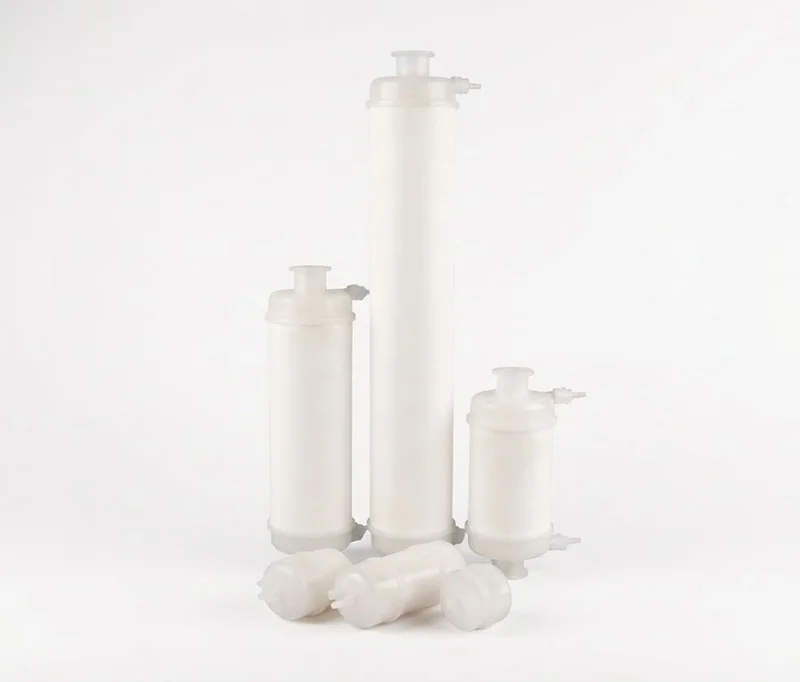
≥ 0.7 m² per 10" media section; small capsules run about 0.02–0.2 m². The double-layer build splits the area across two membranes in the same envelope — longer life at a slightly higher initial ΔP
Inlet / outlet connections
Inlet/outlet 1/4"–1-1/2" with hose barb, sanitary tri-clamp, threaded and quick-connect options; the connections are moulded into the same polypropylene body
Hold-up volume
Small (≈0.02 m²) ≈30 mL; mid (≈0.1 m²) ≈90 mL; 10" class (≈0.7 m²) ≈250 mL. Most of the hold-up is recoverable by blowing down through the open drain
Vent & drain
One polypropylene vent valve on top and one drain valve underneath, both hand-operated; the vent can take a hydrophobic membrane cap to keep the sterile boundary intact
Max operating temperature
Continuous service to 60 °C; withstands 121 °C saturated steam for sterilisation cycles
Max forward differential pressure
Forward 4.0 bar (58 psi) @ 25 °C; 1.0 bar (15 psi) @ 60 °C; reverse 2.0 bar (29 psi) @ 25 °C
Recommended change-out ΔP
A single-use capsule cannot be backwashed or regenerated. Change out when ΔP reaches 3–5× the clean initial value or 2.0 bar (29 psi), whichever comes first
Sterilisation
Autoclave at 121 °C for 30 min, up to 3 cumulative cycles recommended; steam-in-place, EtO and gamma sterilisation are also available
Wetting & flushing
The hydrophilised membrane wets out with WFI or buffer alone, no alcohol needed; PVDF tolerates oxidising chemistries better than most hydrophilic media and holds its flux after peroxide or hypochlorite sanitisation
Extractables & cleanliness
Flushed with purified water to conductivity and TOC limits before shipment; extractables, endotoxin (< 0.25 EU/mL) and TOC batch data available on request
Integrity test
100% integrity tested before shipment; a water-wet 0.22 µm membrane typically bubbles at ≥ 3.1 bar (45 psi), with LRV > 7 bacterial retention validation data available
Packaging
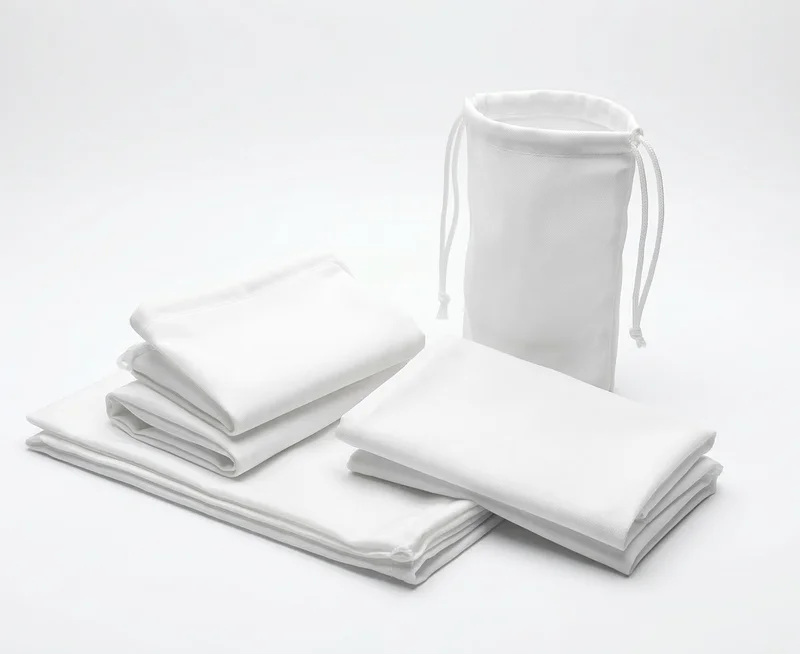
Individually double-bagged, assembled and sealed in a cleanroom; gamma pre-sterilised units available
Regulatory & validation
Wetted materials meet USP Class VI biological reactivity and 21 CFR 177 food-contact requirements; material certificates and batch test reports can be supplied with the shipment

Note: actual compatibility and service life depend on chemical concentration, temperature, flow, differential pressure, upstream contamination load and housing design. Validate under your real process conditions.

Values shown are typical for this product class; actual supply specification follows the quotation and sample datasheet.

Example part number
JY
-BPA5K
-L
-P22
-TCSG
JY
JIUNYUAN Technology
BPA5K
Hydrophilised PVDF microporous membrane with very low protein binding and extractables background; suffix K = kapsule
L
10" 濾材段(≥ 0.7 m²)
P22
0.22 µm
TCSG
Tri-clamp | silicone gasket | gamma pre-sterilised
Selectable options by segment
01

Membrane build (appended to series code)

CodeSpecification
SSingle layer (standard)
BDouble layer, long life (longer service, slightly higher initial ΔP)

e.g. JY-BPA5KB-L-P22-TCSG is the double-layer build; unmarked defaults to single layer. A PVDF support-and-shell version for oxidising feeds is also available — state this when requesting a quotation.

02

Capsule size (effective area)

CodeSpecification
SSmall (≈0.02 m² area, ≈30 mL hold-up)
MMid (≈0.1 m² area, ≈90 mL hold-up)
L10" media section (≥ 0.7 m² area, ≈250 mL hold-up)
03

Retention rating

CodeSpecification
P100.1 µm
P220.22 µm
P450.45 µm
P650.65 µm

0.22 µm is the sterilising grade with LRV > 7 bacterial retention; a water-wet membrane typically bubbles at ≥ 3.1 bar (45 psi).

04

Inlet / outlet style

CodeSpecification
HBHose barb
TCSanitary tri-clamp
THThreaded
QCQuick connect

Ports run 1/4"–1-1/2"; specify the bore at order (the available range depends on the capsule size). Connections are moulded into the polypropylene body, so the wetted path carries no metal parts.

05

Port gasket material

CodeSpecification
SSilicone
EEPDM
FFKM / Viton

The body is thermally welded and has no main O-ring — this segment is the port gasket. FKM is only needed for aggressive fluids.

06

Supply condition

CodeSpecification
NStandard double cleanroom bag, non-sterile
GGamma pre-sterilised

Not every combination is a stock item; uncommon combinations are made to order. Confirm with JIUNYUAN sales before ordering.

ChemicalPVDFPP矽膠 Silicone
— 酸 —
Glacial acetic acidRRLR
Hydrochloric acid, conc.RRNR
Hydrochloric acid, 6NRRNR
Nitric acid, conc.RRNR
Nitric acid, 6NRRLR
Phosphoric acid, conc.RRNR
Sulfuric acid, conc.RRNR
Hydrofluoric acid, 6NRNRNR
— 鹼 —
Ammonium hydroxide, 1NLRRR
Ammonium hydroxide, 3NNRRR
Potassium hydroxide, 3NLRRLR
Sodium hydroxide, 3NLRRR
Sodium hydroxide, 6NNRRR
— 醇類 —
Amyl alcoholRRNR
Benzyl alcoholRRLR
ButanolRRR
Isopropyl alcohol (IPA)RRR
MethanolRRR
— 酮類 —
AcetoneLRRNR
CyclohexanoneLRRNR
Methyl ethyl ketone (MEK)LRRNR
Methyl isobutyl ketone (MIBK)LRRNR
— 油類 —
Cottonseed oilRRR
Lubricating oilRRR
Peanut oilRRR
Sesame oilRRR
— 芳香烴 —
BenzeneLRNRNR
TolueneLRNRNR
XyleneLRNRNR
— 鹵代烴 —
Carbon tetrachlorideLRLRNR
ChloroformLRLRNR
Ethylene dichlorideLRLRNR
Freon TFRLRNR
Freon TMCLRLRNR
DichloromethaneLRLRNR
PerchloroethyleneLRLRNR
TrichloroethyleneNRLRNR
— 二醇類 —
Ethylene glycolRRR
GlycerolRRR
Propylene glycolRRR
— 醚類 —
Diethyl etherRLRLR
Isopropyl etherRRNR
DioxaneRRNR
Tetrahydrofuran (THF)LRLRNR
— 酯類 —
Amyl acetateRRNR
Butyl acetateRLRNR
Cellosolve acetateRRNR
Ethyl acetateRLRR
Methyl acetateRR
Isopropyl acetateRRLR
— 其他 —
AnilineRLRNR
Dimethylformamide (DMF)NRRR
Formaldehyde, 37%RRR
GasolineLRLRNR
Hexane (anhydrous)LRLRNR
KeroseneRRNR
PhenolRRNR
PyridineRLRNR
WaterRRLR
AcetonitrileRLR
  • R = resistant
  • LR = limited resistance, validate on site
  • NR = not resistant
  • — = no data

Ratings are general material-level guidance, not guarantees. Actual concentration, temperature, exposure time and mechanical stress all affect the outcome — validate with samples under your real process conditions before adoption.

Where it fits

The hydrophilic PVDF capsule serves feeds where lost potency is expensive: final sterile filtration of vaccines, biological reagents, sterile eye drops and antibiotics. Among sterilising-grade options, PVDF is usually chosen not for flux but to keep the active substance in the feed from being adsorbed onto the membrane.

Key characteristics

Hydrophilised PVDF is among the lowest protein-binding media available and has a low extractables background. Both matter as direct cost on high-value biologics: adsorbed active substance is never recovered, and anything that leaches out contaminates the feed it was meant to protect.

PVDF tolerates oxidising chemistries better than most hydrophilic media and holds its flux after peroxide or hypochlorite sanitisation, which suits lines on a regular chemical sanitisation cycle. A double-layer long-life option splits the area across two membranes in the same envelope — longer service at a slightly higher initial differential.

Choosing between options

Among sterilising-grade options, the division of labour runs like this:

ProductFormatRating rangeReason to pick it
Hydrophilic PVDF capsule (this)Single-use, no housing needed0.1 – 0.65 µmLowest protein binding, oxidiser-tolerant sanitisation, double-layer long-life option
Highly asymmetric PES capsuleSingle-use, no housing needed0.05 – 5 µmInitial flux and dirt-holding first, with the widest choice of ratings
PVDF microporous pleated cartridgeCartridge, needs a housing0.1 – 1.0 µmA fixed high-volume line where cost per element comes first

Operation & change-out

The hydrophilised membrane wets out with WFI or buffer alone, no alcohol needed. A PVDF support and shell can be specified for oxidising feeds, but that is an option to state at enquiry rather than the standard build. Cumulative autoclave cycles are limited by the polypropylene shell — keep to the datasheet figure.

Choosing the double-layer build: it earns its keep on large batches where change-out downtime is costly. On small batches, or on a line whose differential margin is already tight, the single-layer build is easier to design around. Both carry the same sterilising grade; the choice is purely life against initial ΔP.
What does LRV>7 mean?
A Log Reduction Value above 7 means the filter cuts the challenge bacterial load by over seven log orders, meeting sterilizing-grade validation for high-value biologics.
Why the low protein binding?
Very low protein binding greatly reduces loss of valuable biologics and lowers extractables background, critical for vaccines, reagents and sterile eye drops.
Why the dual-layer option?
The dual-layer design offers higher dirt-holding and longer life, cutting changeover frequency in continuous or large-batch processes and lowering downtime cost.